



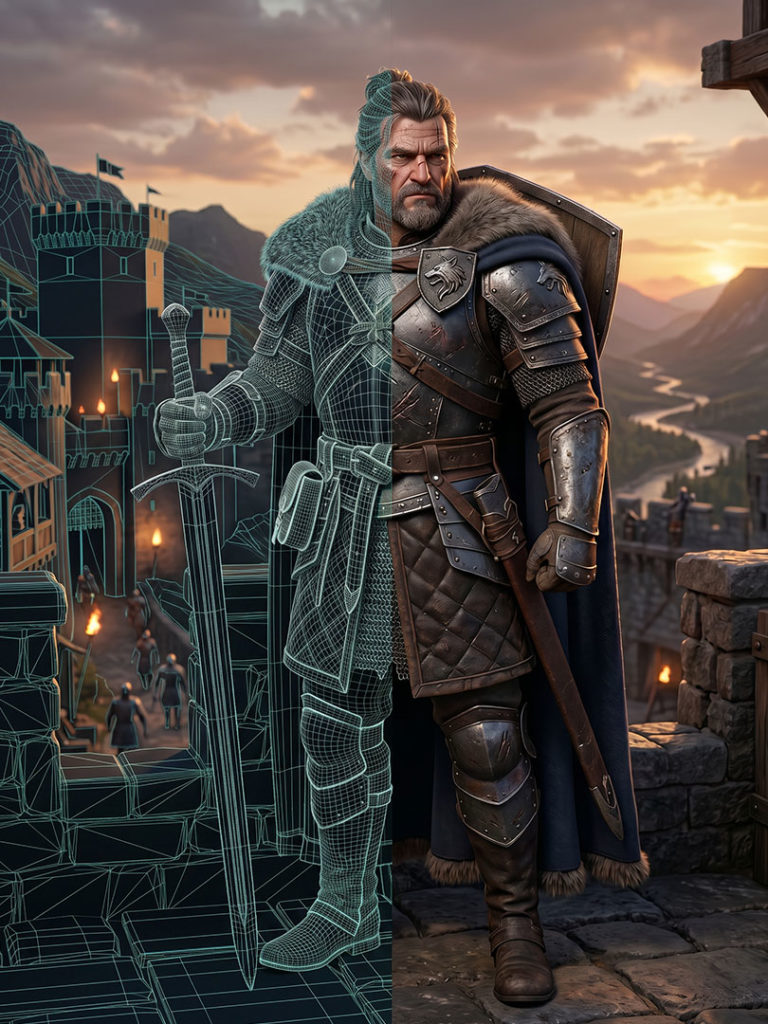
The field of 3D modeling, long regarded as one of the most technically demanding disciplines in computer graphics, is being fundamentally transformed by advances in neural network architectures that can generate, refine, and optimize three-dimensional geometry with unprecedented sophistication. Traditional 3D modeling requires artists to possess deep knowledge of topology, edge flow, UV mapping, and a dozen other technical skills that can take years to master. AI-powered modeling tools are changing this equation by allowing artists to work at a higher level of abstraction, describing what they want to create while the AI handles the technical implementation details. This shift has the potential to dramatically expand the pool of people who can create professional-quality 3D content, with profound implications for industries ranging from game development to medical imaging.
Neural Implicit Surfaces and Novel Representations
The technical foundation of AI-driven 3D modeling rests on several complementary approaches, each suited to different aspects of the modeling pipeline. Neural implicit surfaces represent 3D geometry as continuous functions learned by neural networks, enabling the representation of complex shapes with arbitrary topology and resolution that would be difficult or impossible to achieve with traditional polygon-based approaches. Generative adversarial networks trained on vast datasets of 3D models can produce novel shapes that respect the statistical properties of their training data, generating everything from furniture designs to organic forms that appear natural and well-proportioned. Most recently, diffusion models adapted from the image generation domain have been applied to 3D geometry generation, producing remarkable results in tasks like single-image 3D reconstruction and text-to-3D generation.
Retopology and Mesh Optimization Automation
One of the most practical applications of AI in 3D modeling has been in the area of retopology and mesh optimization. Creating a clean, animatable topology from a high-resolution sculpt or scan is one of the most tedious and time-consuming tasks in the 3D production pipeline, often requiring days of manual work even for experienced artists. AI-powered retopology tools can analyze the geometric features of a high-resolution mesh and generate a clean, efficient quad-based topology that respects the important surface details while minimizing polygon count. Similarly, AI algorithms for UV unwrapping, texture atlas generation, and normal map baking can reduce what were once multi-hour manual processes to near-instantaneous automated operations, freeing artists to focus on creative surface detailing and material development.
Pipeline Integration and Software Ecosystems
The integration of AI modeling tools into established production pipelines has required careful consideration of how these technologies interact with existing software ecosystems. Major 3D applications like Blender, Maya, and 3ds Max have begun incorporating AI-powered features directly into their interfaces, while standalone tools like Kaedim and Masterpiece Studio offer specialized AI modeling capabilities that integrate with standard workflows through plugin bridges and file format compatibility. This gradual integration has allowed studios to adopt AI modeling tools incrementally, applying them first to the most tedious and repetitive tasks before expanding their use to more creative applications as artists become comfortable with the technology and develop trust in its outputs.
Medical and Industrial Applications
The future of AI-powered 3D modeling points toward systems that can understand and respond to complex creative direction in real-time, effectively functioning as collaborative partners in the creative process. Research prototypes already demonstrate the ability to generate complete, animation-ready 3D characters from text descriptions, create detailed environments from photogrammetry input combined with generative filling, and automatically generate variation sets of product designs for client review. As these capabilities mature and become integrated into standard production tools, the role of the 3D artist will evolve from manual craftsman to creative director, guiding AI systems toward desired outcomes while applying human judgment to ensure quality, originality, and artistic coherence in the final result.
Education and Skill Development
The impact of AI modeling extends beyond entertainment into fields like medical imaging, where 3D models reconstructed from CT and MRI scans are essential for surgical planning and medical education. AI systems that can generate detailed anatomical models from scan data with minimal manual cleanup have the potential to make personalized medical modeling more accessible and affordable. In manufacturing and industrial design, AI-generated optimized geometries that respect material properties and manufacturing constraints are enabling the creation of components that are lighter, stronger, and more efficient than traditionally designed alternatives. The convergence of AI modeling with additive manufacturing technologies promises a future where custom-designed, AI-optimized parts can be created on demand for applications ranging from aerospace components to personalized medical implants.
Economic Impact on Studios
The educational pathway for 3D artists is also being transformed by AI modeling tools. Traditional 3D education emphasizes years of technical skill development before students can produce professional-quality work. AI-assisted tools are changing this dynamic, allowing students to create compelling 3D content earlier in their education while developing the technical understanding needed for advanced work. Progressive educational programs are incorporating AI tools into their curricula, teaching students to work effectively with AI as a creative partner rather than viewing it as a threat to traditional skills. This balanced approach ensures that graduates enter the workforce with both the creative vision to direct AI systems and the technical foundation to troubleshoot and refine AI-generated results when necessary.
The Evolution of the 3D Artist
The economic implications of AI-powered modeling are substantial for studios and production houses. By reducing the time required for routine modeling tasks, AI tools enable studios to take on more projects, reduce overhead costs, and compete more effectively in a global marketplace. The cost savings from AI-assisted modeling are particularly significant for small to medium-sized studios, which often operate with tight margins and limited artist headcount. These studios report that AI modeling tools have allowed them to bid on and successfully complete projects that would have been beyond their capacity using traditional methods alone, expanding their business opportunities and competitive position in the market.
The future of AI-powered 3D modeling points toward systems that can understand and respond to complex creative direction in real-time, effectively functioning as collaborative partners in the creative process. Research prototypes already demonstrate the ability to generate complete, animation-ready 3D characters from text descriptions, create detailed environments from photogrammetry input combined with generative filling, and automatically generate variation sets of product designs for client review. As these capabilities mature and become integrated into standard production tools, the role of the 3D artist will evolve from manual craftsman to creative director, guiding AI systems toward desired outcomes while applying human judgment to ensure quality, originality, and artistic coherence in the final result.



Insights & Updates
The latest from the studio — project launches, behind-the-scenes looks, and thoughts on design, technology, and creative process.
Ready to get started?
Hey there! Looking to team up with a creative genius (that’s you!) for an exciting project? I’m all ears! Let’s combine our superpowers and make something awesome together!